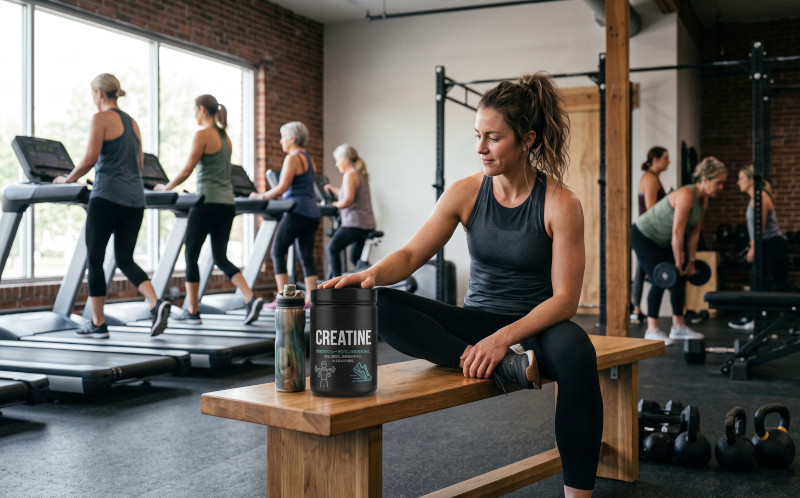
Bodybuilding supplements in Australia cover a wide range of products, ingredients, and quality levels. Navigating that range without a clear framework for what works and why leads most people to spend money on things that sit well below the evidence threshold while overlooking the compounds with the strongest research behind them.
Creatine monohydrate sits at the top of that evidence hierarchy. It’s not the most aggressively marketed supplement in the category, but it’s consistently the one that delivers the most reliable return for people training to build muscle and improve performance.
What Creatine Monohydrate Does
Creatine monohydrate works by increasing the phosphocreatine stored in skeletal muscle. Phosphocreatine is used to regenerate ATP, the primary energy currency muscles burn during short, high-intensity efforts. More phosphocreatine available means faster ATP regeneration, which translates directly to more reps completed, more power output sustained, and better recovery between hard sets before fatigue forces a drop in intensity.
The effect is most pronounced during efforts lasting under 30 seconds at maximal or near-maximal intensity. Heavy compound lifts, sprint efforts, and explosive movements are where creatine’s impact on performance is clearest. For longer, lower-intensity work, the benefit is less direct but still present through improved training volume and recovery across a full session.
Creatine monohydrate is the most researched form of creatine available. Alternatives exist, including creatine HCl, buffered creatine, and creatine ethyl ester, but none have demonstrated meaningful superiority over monohydrate in well-controlled research. Monohydrate is also the most cost-effective option, which matters when you’re taking it daily over an extended period.
The Evidence Behind It
The research base for creatine monohydrate is broader and more consistent than almost any other supplement in the bodybuilding category. Key findings that have replicated across multiple independent trials include improved maximal strength and power output in resistance training, better performance across repeated high-intensity efforts, increased lean muscle mass when combined with resistance training, and emerging evidence for cognitive support under mental fatigue and sleep deprivation.
The kidney damage concern that persists in some fitness communities is not supported by the evidence in healthy adults. This has been investigated extensively. The consensus among researchers is clear: creatine at standard supplementation doses does not impair kidney function in people without pre-existing renal conditions.
Bodybuilding Supplements in Australia: Building a Stack That Works
The bodybuilding supplement market in Australia is large, crowded, and uneven in quality. Bodybuilding supplements in Australia range from well-formulated, independently tested products with meaningful evidence behind them to heavily marketed formulas built around underdosed actives and proprietary blends that obscure what’s actually inside.
A useful framework for building a stack starts with the compounds that have the strongest evidence and the broadest application, then adds further products only when there’s a clear reason to.
The foundation
Protein and creatine cover the foundation for most people training to build muscle. Protein supports muscle protein synthesis and recovery through adequate daily amino acid supply. Creatine supports training performance through improved ATP availability during high-intensity efforts. Both have extensive research behind them. Both are cost-effective. Both produce results that compound over consistent use.
Getting these two right matters more than anything else in the stack.
Performance additions
Pre workout supplements sit on top of the foundation for people training at high intensity. A quality pre workout improves energy, focus, and physical output during sessions through caffeine, citrulline malate, beta-alanine, and other performance ingredients dosed at levels that actually work. The quality difference between pre workout products is significant. Look for full ingredient disclosure, avoid proprietary blends, and match the stimulant level to your established tolerance.
Amino acid supplements, either EAAs or BCAAs, suit people training at high frequency or in a fasted state. They provide fast-absorbing amino acids during the training window when muscle protein breakdown is elevated and full protein shakes aren’t practical.
Recovery additions
Casein protein taken before sleep supports overnight muscle repair by providing a sustained amino acid release across the longest fasting period of the day. Research on pre-sleep protein intake consistently shows improved recovery and muscle retention outcomes compared to no protein before bed.
ZMA supports sleep quality and replenishes zinc and magnesium, both of which are lost through sweat and commonly deficient in athletes training at high frequency. Better sleep produces better recovery, which directly supports muscle building outcomes over time.
What to skip
Several products are heavily marketed toward bodybuilding without evidence that justifies the cost. Over-the-counter testosterone boosters typically contain ingredients with weak or inconsistent evidence for raising testosterone meaningfully in healthy adults. Standalone glutamine adds cost without meaningful benefit for people already hitting adequate daily protein targets. Premium creatine forms charge significantly more than monohydrate without producing better outcomes in well-controlled research.
What to Look for When Buying Bodybuilding Supplements in Australia
These quality markers apply across the category and are the most reliable way to assess any product before buying.
Full ingredient disclosure means every ingredient and its dose listed individually. No proprietary blends. Independent batch testing by an accredited third-party laboratory confirms that the label reflects what’s actually in the product. Facilities certified to ISO and HACCP standards operate under strict production controls that are a meaningful indicator of consistency across batches. Verified reviews at volume across thousands of purchases provide a more reliable signal than curated testimonials or sponsored endorsements.
FAQs
How long does creatine take to work?
Most people notice improved training performance within two to four weeks of consistent daily use. The effect builds as muscle creatine stores saturate gradually. A loading phase of 20g daily split across four doses for five to seven days saturates stores faster, reducing the time to full effect to around one week.
Do I need to cycle creatine monohydrate?
No. Continuous daily use at three to five grams is safe and effective. There is no evidence that cycling on and off produces better outcomes than consistent use. The benefit of creatine comes from sustained muscle saturation over time.
Is creatine monohydrate suitable for women?
Yes. The performance and recovery benefits apply regardless of sex. Women tend to have lower baseline creatine stores relative to muscle mass, which means supplementation often produces a noticeable effect. Concerns about water retention are frequently overstated — the effect is modest and intracellular.
How do I know if a bodybuilding supplement is worth buying?
Check the ingredient list for full disclosure with no proprietary blends, verify independent batch testing, confirm the active ingredients are dosed at levels supported by research, and look for verified reviews at volume from actual purchasers. Price and packaging tell you nothing reliable about quality.
Can beginners use bodybuilding supplements?
Yes, selectively. Protein powder and creatine are appropriate for anyone training consistently, regardless of experience level. Pre workouts should be introduced gradually with a lower-stimulant formula first. More specialised products are best added once the foundation is established and there’s a clear reason to include them.